
Some of the links on this website are affiliate links, which means that I may earn a small commission at no additional cost to you if you click through and make a purchase. I only recommend products or services that I personally use and believe will add value to my readers. All opinions expressed here are my own. Thank you for supporting Easy Good Food!
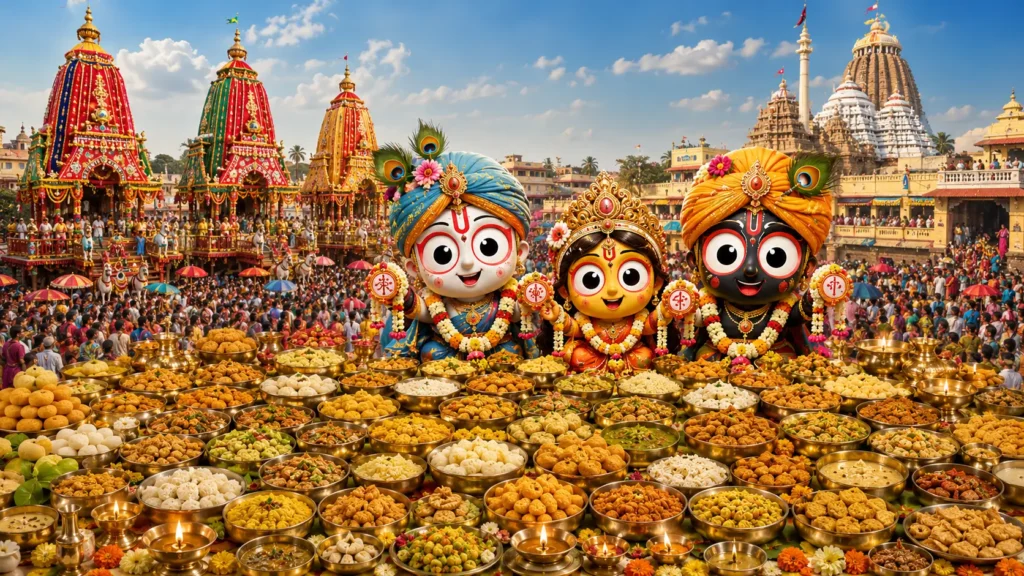
Ever found a kitchen running on divine physics?
In this extensive Jagannath Puri Mahaprasad guide, we delve into the incredibly surprising culinary science and culture of the largest organic kitchen on the planet.
Welcome to the grand culinary hub of Lord Jagannath in Puri.
Every single day, thousands of devotees gather at the iconic Ananda Bazar courtyard. They are all waiting for just one thing: a taste of the legendary Mahaprasad.
But this isn’t just a kitchen. It is a living time machine.
Inside the sacred walls, modern culinary rules are completely turned upside down. The chefs cook without electricity, without gas, and without a single ingredient introduced to India after the 16th century.
Yes, that means your everyday kitchen staples are strictly forbidden here!
So, how does this massive, ancient food system feed millions without ever losing its signature aroma?
Grab a seat. We are pulling back the curtain on the world’s most mysterious kitchen. From gravity-defying cooking methods to the exact architectural secrets of the Chappan Bhog, here is your ultimate backstage pass to the magical kitchen world of the Lord.
⏰ Mahaprasad Timeline: 6 Daily Dhupas (Meal Slots)
Managing three meals a day at home even with modern kitchen appliances feels overwhelming at times. It is surprising to discover how a kitchen prepares a massive, complex menu around the clock. The temple kitchen operates like a highly synchronized culinary machine, dividing its offerings into six distinct, sacred slots called Dhupas.
Devotees wait for hours to get their share of the sheer volume of the Chappan Bhog (56 items). The secret to understanding it is simple: it is not served all at once. Instead, the meals follow a structural timeline from dawn until midnight.
Here is the daily culinary schedule of Lord Jagannath (translates to the Lord of the Universe), mapped out slot by slot:
1. Gopal Ballabh Bhog (The Holy Breakfast)
Timing: 8:30 AM
Meal Profile: Light, refreshing, and sweet morning treats to gently wake up the deities.
Core Items: This slot features sweetened coconut gratings (Kora), puffed rice (Khai) coated in jaggery, fresh curd, ripe bananas, and chipped rice (Pachedi). It is a clean, raw, and comforting start to the day.
2. Sakala Dhupa (The Morning Brunch)
Timing: 10:00 AM
Meal Profile: The first major cooked meal of the day. It is rich, fragrant, and highly enticing.
Core Items: This is where the kitchen’s architectural baking shines. It features the famous Kanika (sweet, fragrant yellow rice), Ada Pachedi (a bright ginger-coconut chutney), and traditional unleavened steamed cakes like Enduri Pitha, which are wrapped in fragrant turmeric leaves before steaming.
3. Bhoga Mandapa Bhog (The Mid-Day Public Feast)
Timing: 11:00 AM
Meal Profile: This is the massive culinary operation that feeds the masses. The food is cooked in the main courtyard stoves to meet the vast demand of the Ananda Bazar.
Core Items: This slot is dominated by Sankhudi Bhoga (wet cooked items). It includes towering portions of white rice, the legendary lentil-and-root medley Dalma, mustard-paste curries like Besara, and plenty of leafy greens (Saga).
Ananda Bazaar isn’t just a market; it is the world’s largest open-air eatery where thousands gather daily to share hot, freshly cooked clay-pot meals without.
4. Madhyanha Dhupa (The Royal Lunch)
Timing: 12:30 PM – 1:00 PM
Meal Profile: The most crucial, elaborate, and elite ritualistic meal of the day.
Core Items: The deities are offered sophisticated heritage delicacies during this royal hour. It includes deep-fried sweetmeats like Mathapulia, massive intricate cakes like Bada Pitha, and deeply layered, slow-cooked lentil pots that have simmered to perfection under trapped steam.
5. Sandhya Dhupa (The Evening Tiffin)
Timing: 7:00 PM – 8:00 PM
Meal Profile: A comforting, cooling evening meal designed to refresh the deities after the day’s rituals.
Core Items: A key highlight here is Subasa Pakhal—water-soaked cooked rice delicately scented with fragrant flowers, grated ginger, and curds. It is accompanied by fresh batches of Kanika and light, aromatic sweet dals.
6. Bada Singhara Bhog (The Late-Night Supper)
Timing: 11:00 PM
Meal Profile: The final, deeply soothing offering of the night before the Lord goes to rest.
Core Items: This slot is entirely dedicated to decadent, comfort confectionery. It prominently features warm milk flavored with mild spices and the legendary Amalu (the sacred temple Malpua).
💡 Quick Summary: 56 Bhog Mahaprasad Timeline at a Glance
| Meal Slot (Dhupa) | Timing | Nature of the Offering |
| 1. Gopal Ballabh Bhog | 8:30 AM | Breakfast: Light raw sweets, puffed rice, curd, and fruit. |
| 2. Sakala Dhupa | 10:00 AM | Brunch: Cooked items like Kanika and steamed Enduri Pitha. |
| 3. Bhoga Mandapa Bhog | 11:00 AM | Public Feast: Major rice pots, Dalma, and Besara. |
| 4. Madhyanha Dhupa | 12:30 PM | Royal Lunch: Mathapulia, complex deep-fried cakes, and rich dals. |
| 5. Sandhya Dhupa | 7:00 PM | Evening Tiffin: Scented water-soaked Pakhal rice and light sweets. |
| 6. Bada Singhara Bhog | 11:00 PM | Supper: Sacred Amalu (Malpua) and spiced warm milk. |
🍽️ Jagannath Puri Mahaprasad Guide Deep Dive
When you hear about the legendary Chappan Bhog (the 56 sacred offerings), it is easy to imagine a single, overwhelming feast spread out all at once. But the world’s largest kitchen doesn’t operate on chaos. Instead, it runs on an extraordinarily disciplined, structural system refined over hundreds of years.
To truly understand how this massive culinary operation feeds thousands of devotees daily, you have to look at how the food itself is classified. The temple chefs divide the entire menu into two primary architectural categories: Sankhudi and Sukhila. Decoding this split is the ultimate key to understanding how the Mahaprasad is prepared, how long each dish lasts, and how you can bring these exact heritage principles into your own kitchen.
“Sankhudi” vs. “Sukhila” Classification
When you hear about the Chappan Bhog (56 sacred items), it is easy to picture a single, massive buffet line. But structurally, the temple kitchen divides the entire menu into two distinct architectural categories: Sankhudi and Sukhila.
Understanding this split is the ultimate secret to decoding how the Mahaprasad is prepared, how long it lasts, and how it is shared with the world.
1. Sankhudi Bhoga: The Warm, Wet Comfort Mains
Think of Sankhudi as the soul-satisfying, everyday comfort food of the temple. These are the wet, freshly cooked dishes prepared using water, earthen pots (Kudua), and slow vertical steam dynamics.
Because these items are fresh and high in moisture, they are meant to be consumed immediately at the Ananda Bazar courtyard while warm.
The Main Players: This category holds the legendary Ghee Anna (fragrant rice laced with pure ghee), Thali Anna (plain boiled indigenous rice), and Puri-style Dalma (lentils slow-cooked with native root vegetables).
The Flavor Profile: It also includes rich, mustard-infused vegetable purees like Besara and simple, grounding leafy greens (Saga).
2. Sukhila Bhoga: The Dry, Heritage Confectionery
Sukhila translates literally to “dry.” This category is a masterclass in ancient Indian pastry geometry. These items skip the water-boiling process entirely and are instead deep-fried in pure cow ghee and finished with dry sugar or jaggery coatings.
Because they have zero moisture content, Sukhila Bhoga items have an incredible shelf life and can be easily traveled with.
The Main Players: This is where the temple’s iconic sweet treats live. It features the world-famous, multi-layered Puri Khaja, the crisp, tongue-shaped Jive Gaja, and the dense, syrupy, rectangular blocks of Khasta Gaja.
The Ultimate Nightcap: It also features Amalu (the sacred temple Malpua), which acts as the final sweet offering of the night.
🍯 The Kitchen Science Connection: If you are planning to bring these sacred flavors into your home kitchen, the Sukhila sweets are the perfect place to start. Unlike wet curries, these dry sweets can be stored in clean, airtight glass jars at room temperature for up to 15 to 20 days without losing their crisp, flaky texture.
🕊️ The Lifespan of Nirmalya: The Ultimate Spiritual Token
It is difficult to understand the Sankhudi classification without knowing its miraculous transformation into Nirmalya.
What happens when the wet Sankhudi rice isn’t eaten immediately? It isn’t wasted. The leftover sacred rice is spread out on a clean, pristine white cloth and allowed to dry completely under the hot sun. Once all the moisture evaporates, it turns into tiny, rock-hard, dehydrated rice tokens called Nirmalya.
Nirmalya holds immense spiritual value for devotees. Because the moisture is entirely gone, a small pouch of these sun-dried rice grains can be stored in your home altar indefinitely for months or even years without spoiling. Devotees across the world take a single grain of Nirmalya daily on an empty stomach as a pure, direct blessing from Lord Jagannath.
🚫 The “Strictly Forbidden” Ingredient Guide (The Culinary Gap)
If you step into a modern Indian kitchen, you will almost certainly find potatoes, tomatoes, and green chilies anchoring nearly every curry. But if you try to bring those exact items into the kitchen of Lord Jagannath, they won’t make it past the door.
This isn’t just a random dietary preference; it is a rigid, historical timeline cast in stone.
The ultimate secret of the temple kitchen is its 16th-century culinary cutoff line. The cooking laws state that the hearths will only accept indigenous ingredients that were native to the Indian subcontinent before the arrival of foreign traders—specifically the Portuguese, British, and Dutch. Anything introduced to Indian soil after this era is strictly considered a “foreign intervention” and is barred from the sacred pots.
For a modern home cook trying to recreate these recipes, this creates a massive culinary puzzle. How do you build rich, satisfying, and deeply flavorful gravies when your primary flavor-anchors are completely stripped away?
🛑 The Blacklisted Mainstays
Here are the everyday kitchen staples that are strictly forbidden inside the temple walls:
- Bulking Agents: White potatoes, cauliflowers, and cabbages.
- Tang & Acid: Tomatoes.
- Heat Elements: Green chilies and red chili powder.
- Finishing Garnishes: Fresh coriander leaves.
🧪 The Kitchen Science of Substitution
Giving up these ingredients doesn’t mean your food has to taste flat or watery. In fact, it forces you to practice a beautiful form of culinary science – rebuilding texture and heat using ancient, native crops.
By swapping out the new-world imports for traditional ingredients, you unlock an incredibly clean, complex, and delicate flavor profile where the natural sweetness of the food actually shines through.
Here is your exact structural blueprint for smart temple-style swaps:
1. Rebuilding Bulk & Structure (Instead of Potato & Tomato)
Problem: Potatoes provide thick starch to a gravy, while tomatoes add body and a subtle umami depth. Without them, curries can easily turn thin and watery.
Sacred Swap: Use Saru (taro root), Kacha Kela (raw banana), Kankada (spine gourd), and Shim (flat beans).
Science: When slow-cooked under steam, taro root and raw banana release thick, velvety native starches that bind the curry together beautifully, giving you that rich, comforting mouthfeel of a traditional *Dalma* without a single spud in sight.
2. Delivering Clean, Directional Heat (Instead of Green/Red Chili)
The Problem: Chilies give food an instant, sharp, biting heat that hits the back of the throat.
Sacred Swap: Use pure, freshly crushed Gol Maricha (black pepper).
Science: Black pepper delivers a warm, creeping, sophisticated heat that builds slowly on the palate. Unlike red chili powder, which can mask subtle flavors, black pepper cuts through the richness of pure cow ghee while allowing the earthiness of the lentils to take center stage.
3. Framing the Aromatic Base (Instead of Standard Cumin)
Problem: While standard cumin is highly common today, temple flavors lean into gentler, cooling aromatics to maintain a pure *Sattvic* profile.
Sacred Swap: Use a combination of Mauri (fennel seeds) and fresh whole ginger.
Science: Sautéing fennel seeds in hot ghee releases an incredibly sweet, anise-like aroma that mimics the natural freshness you would typically seek from fresh herbs, while ginger provides the grounding, sharp baseline that ties the entire dish together.
🚪10 Divine Puri Temple Kitchen Hacks That Inspire the Modern Culinary Rules
🏛️ Part 1: The Laws of the Sacred Hearth
1. The 16th-Century Culinary Time Machine
Step into the temple kitchen, and you are literally stepping back in time. The menu here has been frozen for centuries. The ultimate secret? Absolutely no new-world ingredients are allowed past the gates. Modern Indian household staples like potatoes, tomatoes, cauliflowers, cabbages, and green chilies are completely banned because they were introduced by foreign traders long after the temple rituals were codified. Here, history dictates the flavor.
💡 The Art of the Mindful Swap: Many home cooks panic when you tell them to drop everyday flavor-anchors like tomatoes or chilies, fearing the final dish will taste flat. But here is the ultimate kitchen truth: skipping heavy ingredients doesn’t kill the taste; it opens the door to deeper delicacy and enhanced flavor profiles. By stepping away from dominant flavors, you allow alternative, subtle spice combinations to shine in every single bite.
I put this exact culinary philosophy to the test in my own kitchen when developing a signature [Vegan & Gluten-Free Crispy Vegetable Cutlet]. By completely skipping the usual mainstays—no onion, no garlic, no ginger, and absolutely zero added sugar—and focusing instead on the texture of native roots and clean, directional seasoning, the natural sweetness of the vegetables emerged. The result? A stunningly clean flavor profile where everyone loved the pure, crunchy bites without ever realizing what was “missing.”
2. The Ghee-Only Ultimatum (No Oils Allowed!)
If you think you can cook a holy meal with a splash of refined sunflower oil or pungent mustard oil, the temple kitchens will politely show you the door. The strict rule of the hearth dictates that pure cow ghee is the sole medium allowed to touch the fire. This keeps the smoke profile clean, the spiritual energy pure, and gives the entire complex that legendary, rich aroma that hits you the moment you step into Puri.
3. VIP Water from the Twin Holy Wells
You won’t find municipal tap water or modern water purifiers inside this ancient kitchen setup. Every drop of water used to wash the grains, boil the lentils, and mix the doughs comes exclusively from two dedicated, ancient open wells located right inside the temple compound: Ganga and Yamuna. This water is reserved strictly for the deities’ meals and is considered spiritually pure from the source.
🍲 Part 2: The Gravity-Defying Kitchen Science
4. The Sky-High Clay Stack (Physics, but Make it Divine)
This is the ultimate engineering marvel that baffles modern onlookers. The chefs don’t cook on massive flat grills. Instead, they stack seven clay pots (Kudua) vertically on top of each other over a single wood fire hearth. The ultimate plot twist? The topmost pot always cooks first, while the bottom pot closest to the actual fire cooks last. The narrow clay necks trap and channel the rising steam pressure perfectly from the top down.
💡 The Modern Kitchen Connection: If this multi-tiered vertical steam system sounds familiar, it’s because your modern electric rice cooker operates on the exact same thermodynamic principle! Just like the temple hearth, you can layer your cooking. While a hearty, comforting lentil curry is simmering away at the base of the cooker, you can place a perforated steaming basket right above it. The rising steam cooks your vegetables or root crops perfectly on the upper tier simultaneously, saving time and energy.
Want to unlock the full potential of this multi-tasking appliance? Check out our ultimate guide to Electric Rice Cooker Hacks & Smart Steam Systems to master layered cooking at home.
5. Fire That Plays Hide-and-Seek
The massive mud-and-brick stoves (Chulas) are architectural wonders in themselves. The clay pots don’t just sit directly on top of roaring open flames. The internal chambers of the stoves are built with specific structural channels that circulate the heat indirectly around the pots. This ensures a gentle, slow-braising micro-environment that coaxes out the natural flavors of the lentils and roots without ever scorching them.
6. The Heartbreak Rule: One Meal, Then It’s Broken
In this kitchen, there is no dishwashing duty for the main cooking vessels. Every single Kudua (earthen pot) follows a strict one-way lifespan protocol. A clay pot is used to cook and serve exactly once. The moment the meal slot is over, the porous pot is discarded or broken, ensuring that a brand-new, sterile, and highly absorbent clay vessel is used for the next round of cooking.
🍯 Part 3: The Confectionery Masterclass
7. The Illusion of the Sugar Syrup (The Amalu Trick)
When you look at the glossy, deep-mahogany glaze on a temple Amalu (Malpua), you naturally assume it was dipped in a heavy sugar syrup after frying. But that is the ultimate pastry secret: it skips the syrup bath entirely! The rich sweetness is achieved by dissolving raw jaggery directly into the batter. When it hits the boiling ghee, the internal sugars caramelize beautifully from the inside out, creating lacy, crisp edges and a smoky sweet center.
8. Ancient Pastry Geometry: The Secret of the Fold
Achieving the melt-in-the-mouth flakiness of Jive Gaja and Khasta Gaja without using modern chemical leaveners like baking powder or baking soda is a masterclass in physics. The secret lies in a meticulous, ancient folding technique. The dough is rolled, layered with ghee, and folded repeatedly to trap microscopic pockets of air. When fried, these pockets expand, creating hundreds of distinct internal sheets ready to hold onto flavor.
🕊️ Part 4: The Spiritual Alchemy
9. The Silent Cooking Code
The chefs (Suaras) don’t shout orders across the kitchen line. In fact, they wear a clean cloth covering their mouths while preparing the food. While this acts as a brilliant modern hygiene practice, the root secret is spiritual: it ensures that no human breath, spoken word, or stray thought defiles the purity of the food before it is formally presented to the Lord. The kitchen runs on silent devotion.
10. The Ultimate Shape-Shifting Shadow
Here is the final, most sacred secret of the entire culinary system: food cooked in the kitchen is technically just called Bhoga (an offering) while it is being prepared. It only undergoes a magical, incorruptible spiritual transformation into Mahaprasad once it enters the inner sanctum and the shadow of Goddess Bimala falls upon it during the final consecration ritual.
🕊️ Bringing the Divine Hearth Home
Recreating the sacred flavors of the Jagannath Puri Mahaprasad is far more than a simple weekend cooking project. It is a beautiful exercise in mindfulness, history, and pure culinary science. By stepping away from modern shortcuts like tomatoes, potatoes, and heavy commercial spice powders, you aren’t limiting your kitchen—you are unlocking a timeless way of eating that honors the natural, clean sweetness of native ingredients.
Whether you are deep-frying the delicate, microscopic sheets of a crispy Gaja, letting a rich Dalma slow-cook under a heavy steam-locked lid on your induction stove, or enjoying the unique caramel richness of a syrup-free Amalu, you are actively bringing a centuries-old spiritual legacy right onto your dining table.
Cooking Sattvic food without onion and garlic doesn’t mean compromising on taste. It is an art form that rewards patience, precise heat control, and the right structural swaps. So, clean your hearth, fire up your kitchen appliances with intention, and experience the profound joy of pure, conscious cooking.
Jai Jagannath!
Enjoyed this post? Join our community of home cooks! Subscribe to our YouTube channel and follow our social media handles for daily Vrat-friendly tips, induction cooking hacks, and authentic Indian flavors delivered straight to your feed.