
Some of the links on this website are affiliate links, which means that I may earn a small commission at no additional cost to you if you click through and make a purchase. I only recommend products or services that I personally use and believe will add value to my readers. All opinions expressed here are my own. Thank you for supporting Easy Good Food!
Kitchen traditions passed down through generations often carry warmth, flavor, and wisdom. However, some long-standing kitchen habits are built on common food safety myths rather than scientific fact. From trusting aged spice boxes to rinsing raw poultry under the tap, relying on outdated practices can expose your household to hidden health risks like bacterial food poisoning and toxic chemical exposure.
Here is the truth behind six widespread food safety myths exposed, along with the facts you need to keep your kitchen safe.
⚠️ STAY TUNED: We aren’t just dropping bad news. Stick around until the end for our “Pro-Level Hygiene Guide”—a no-gatekeeping list of easy fixes to turn your kitchen into a high-performance, toxin-free zone.
Are These 6 Traditional Kitchen Habits Making You Sick?
Culinary misconceptions are part of the kitchen practices in every household. While these habits do not impose immediate evident health risks, it is not safe to overlook the pathogenic threats popping up from the complexities of microbial growth or modern food processing. What worked in a cool, open-air kitchen fifty years ago might not hold up against today’s humidity and lifestyle.
The truth is, some of our most instinctive habits—like trusting a “sniff test” or leaving leftovers on the counter to cool for hours—could be doing more harm than good. These practices feel second nature, but they often bypass basic scientific principles of hygiene, inadvertently turning a nutritious meal into a potential health hazard.
Before you start your next meal prep, it’s time to look at your routine through a modern lens. Are your inherited habits keeping your family safe, or are they outdated misconceptions? Let’s dive into the most serious food safety myths that still linger in Indian kitchens and see how many you currently believe.
1. Spices Never Expire (The Truth About Aflatoxins)
The Myth: Ground spices, whole seeds, and homemade masala powders last indefinitely because they don’t spoil or smell rancid like fresh produce.
The Fact: While dry spices rarely grow visible mold on the surface, they slowly degrade over time. More critically, improperly stored spices—especially in humid kitchens—can harbor invisible, toxic molds like Aspergillus. These molds produce aflatoxins, potent fungal toxins linked to liver damage and long-term health complications. Furthermore, essential oils evaporate over 6 to 12 months, taking away their medicinal properties and flavor profile.
- Safe Practice: Store spices in airtight, opaque glass containers away from direct heat and moisture (never right above the stove). Buy whole spices in smaller batches, grind them as needed, and discard ground masalas after 6 to 9 months. For exact techniques on keeping your masalas fresh and moisture-free year-round, see our detailed guide on wet and dry spice preservation.
2. Washing Raw Chicken in the Sink Cleanses It
This is perhaps the most dangerous habit in Indian kitchens. When you rinse raw chicken or mutton in the sink, the water splash carries bacteria like Salmonella up to 3 feet away—landing on your countertops, clean utensils, and even your face.
The Myth: Rinsing raw chicken, mutton, or fish under running tap water removes surface dirt, slime, and harmful bacteria before cooking.
The Fact: Washing raw meat does not destroy bacteria—cooking it to the right internal temperature does. In fact, washing poultry under a running faucet causes bacterial splashback. Water droplets carrying pathogens like Salmonella and Campylobacter can spray up to 3 feet in every direction, contaminating nearby countertops, drying dishes, dishwashing sponges, and fresh fruit.
- Safe Practice: Skip the rinse entirely. Transfer raw meat directly from the packaging into your cooking vessel. If you must remove surface moisture or debris, pat the meat gently with a paper towel and immediately dispose of the towel in the bin. Thoroughly sanitize your hands and cutting boards afterward.
Understanding the Risk of Chicken Splash
When you rinse raw chicken under a running kitchen faucet, the force of the water striking the slick, uneven surface of the meat creates an invisible, fine aerosol mist—a phenomenon food safety researchers refer to as “chicken splash.”
Far from cleaning the poultry, high-speed water droplets act as tiny vehicles for dangerous pathogens natively present on raw meat, primarily Salmonella and Campylobacter.
The Physics of Kitchen Cross-Contamination
- The 3-Foot Radius: High-speed laboratory imaging shows that washing poultry under a standard tap can send micro-droplets of contaminated water spraying up to 3 feet (nearly 1 meter) in every direction.
- Hidden Targets: This invisible spray lands on surrounding areas that rarely get cooked or heat-sterilized—such as dishwashing sponges, drying racks, washed cutlery, countertops, and nearby fresh produce intended for raw salads.
- Bacteria Survive, the Water Leaves: Rinsing chicken removes almost zero bacteria bound to the meat’s muscular tissue and skin. Instead, it merely redistributes those pathogens around your sink area, converting a localized ingredient into a kitchen-wide contamination zone.
How to Handle Raw Chicken Safely Without Washing
- Unpack Directly into the Pot: Move raw poultry straight from its packaging into your cooking vessel, marinade bowl, or pressure cooker to keep bacteria contained.
- Pat Dry, Don’t Rinse: If you need to remove excess surface moisture or debris, pat the meat gently with a single-use paper towel. Immediately throw the towel into a closed trash bin.
- Heat is the Only True Sterilizer: Thermal energy destroys Salmonella and Campylobacter. Cooking chicken to an internal temperature of 74°C (165°F) instantly renders it completely safe to eat.
- Sanitize the Perimeter: Wash your hands with soap and warm water for at least 20 seconds immediately after handling raw poultry. Disinfect any cutting boards, knives, or counters that came into direct contact with the meat or its packaging.
🔬 The Science Behind “Chicken Splash”: Research published in Physics of Fluids (Carmody et al., 2022) showed that when water streams hit raw poultry, the soft texture of the meat creates surface deformation (divots) that dramatically increases splashing compared to hard surfaces. These micro-droplets act as vehicles, spreading bacterial colonies across countertops and sink areas.
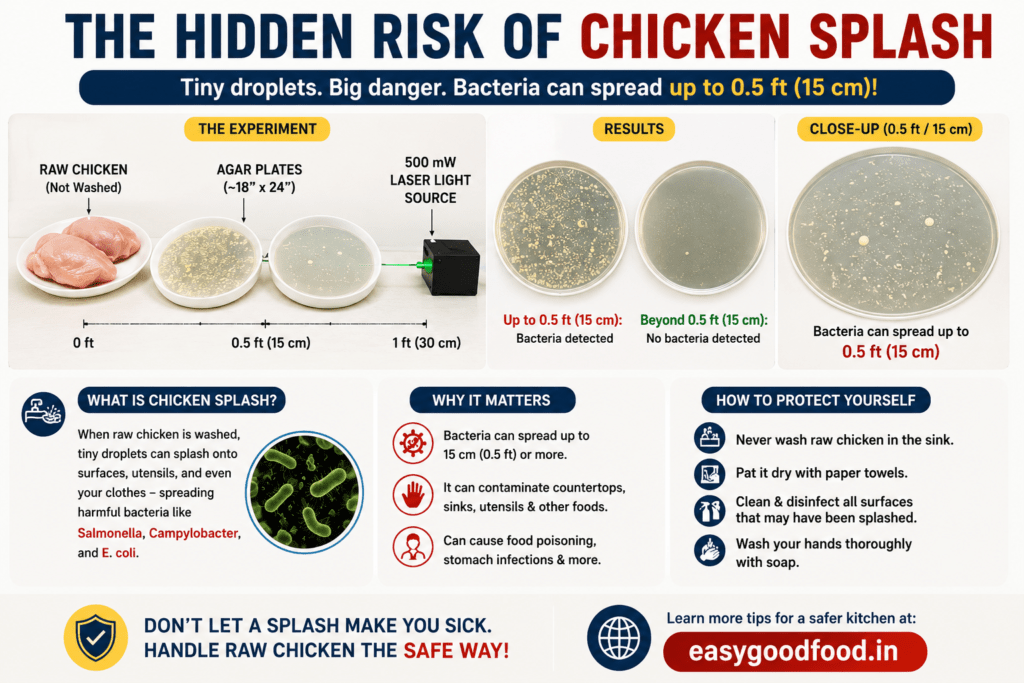
CD Carmody’s Study on Chicken Splash – Key Takeaways
- Surface Deformation: Water striking soft chicken meat creates small divots that cause splashing even under low-flow conditions where hard surfaces wouldn’t splash.
- Faucet Height Matters: Higher faucets increase flow instability, significantly increasing splash distance and droplet ejection into the kitchen space.
- Microbial Growth: The study used large agar plates around the sink setup to prove that culturable bacteria transferred directly via these splashed water droplets.
3. The Silent Threat: Heavy Metals in Our Tap Water
The Myth: Boiling tap water for a few minutes removes all contaminants, making it completely safe for drinking, cooking rice, and preparing soups or dal.
The Fact: While boiling effectively kills biological contaminants like bacteria, viruses, and parasites, it does not remove chemical pollutants or heavy metals. In fact, boiling water causes evaporation, which actually concentrates non-volatile toxic heavy metals like lead, arsenic, cadmium, and nitrates present in untreated ground or municipal tap water.
- Safe Practice: Use filtered water (RO, UV, or heavy-metal certified filtration systems) for all direct cooking applications where water is absorbed into the food—such as boiling rice, simmering lentils, or making gravies and soups.
4. Leaving Cooked Food Out for “Natural” Cooling
The Myth: Hot cooked food must cool completely to room temperature on the kitchen counter for hours before it can be placed in the refrigerator.
The Fact: The temperature zone between 5°C and 60°C (40°F to 140°F) is known as the Danger Zone. Within this range, foodborne bacteria can double in number every 20 minutes. Leaving a heavy pot of dal, curry, or cooked rice on the counter to cool for hours allows bacteria to multiply rapidly, producing heat-resistant toxins that won’t be destroyed even if you reheat the food later.
- Safe Practice: Never leave perishable cooked food at room temperature for more than 2 hours (or 1 hour if room temperatures exceed 32°C). Divide large quantities into smaller, shallow containers to speed up cooling and place them in the refrigerator promptly.
5. Reheating Food Multiple Times is Safe
The Myth: As long as food is brought to a boiling point, it can be repeatedly reheated over several days without any loss of safety or quality.
The Fact: Each time food cools down and is reheated, it passes through the bacterial Danger Zone once more. Repeated heating cycles degrade nutrients, alter food structure, and encourage spore-forming bacteria like Bacillus cereus (commonly found in cooked rice) to produce toxins that survive high heat.
- Safe Practice: Reheat only the portion you intend to consume immediately. Bring liquid foods (dals, gravies, soups) to a rolling boil, and ensure solid foods reach an internal temperature of 75°C (165°F) throughout. Do not reheat leftovers more than once.
6. Plastic Containers are “Microwave Safe” if they don’t Melt
The Myth: If a plastic container or takeaway dabba does not warp, melt, or burn in the microwave, it is completely safe for heating food.
The Fact: The term “microwave safe” is a manufacturer rating indicating that the container won’t melt or damage your appliance. As noted by the Canadian Cancer Society’s guidance on microwaving plastic, it does not mean the material is completely inert when exposed to high heat.
When plastic containers are heated—especially with oily, acidic, or spicy gravies—high temperatures accelerate chemical migration. In fact, clinical research in The American Journal of Medicine highlights how heat causes endocrine-disrupting chemicals (EDCs) like phthalates and BPA, along with microplastics, to leach into food.
- Safe Practice: Transfer food to heat-resistant glass, ceramic, or high-grade stainless steel containers before microwaving. Never heat food in single-use takeaway plastic boxes or plastic wrap.
Food Safety Myths & Facts – FAQs
Why should you never wash raw chicken in the sink?
Washing raw poultry under running tap water does not destroy bacteria. Instead, the force of the water creates a micro-droplet spray (known as "chicken splash") that can spread pathogens like Salmonella up to 3 feet away onto sink handles, drying dishes, countertops, and fresh produce.
Do ground spices ever expire or go bad?
While ground spices rarely spoil like fresh food, they lose their essential volatile oils over 6 to 12 months. More importantly, spices stored in humid kitchens can develop invisible fungal toxins called aflatoxins, which carry long-term health risks. Spices should be kept in airtight containers away from stove heat and moisture.
Is it safe to reheat cooked food multiple times?
No. Every time food is cooled and reheated, it passes through the bacterial "Danger Zone" (5°C to 60°C). Repeated heating cycles degrade nutrients and encourage spore-forming bacteria like Bacillus cereus to produce heat-resistant toxins. Only reheat the specific portion you plan to eat immediately.
Food Safety Myths and Facts: Summary Guide
| Topic | The Popular Myth | The Proven Fact |
| Spices | They last forever. | Old spices can harbor dangerous aflatoxins and lose essential oils. |
| Raw Chicken | Washing cleans surface bacteria. | Washing spreads Salmonella droplets up to 3 feet around the sink. |
| Tap Water | Boiling clears all impurities. | Boiling concentrates heavy metals like lead and arsenic. |
| Cooling Food | Must sit out until completely cold. | Sitting out over 2 hours pushes food into the bacterial Danger Zone. |
| Reheating | Safe to reheat endlessly if boiled. | Repeated thermal cycles trigger spore formation and toxin build-up. |
| Plastics | Unmelted plastic is safe plastic. | Heat leaches endocrine-disrupting chemicals and microplastics into food. |
Incorporate Modern Safety Practices in Traditional Kitchens
Rethinking age-old habits doesn’t mean letting go of traditional wisdom; it means equipping your kitchen with the best of both science and heritage. By recognizing these common food safety myths—from properly handling spices to keeping toxic plastics away from heat—you ensure that every meal you serve is as safe as it is delicious. Small adjustments in how you wash, store, and reheat food go a long way in protecting your family’s health every single day.
Enjoyed this post? Join our community of home cooks! Subscribe to our YouTube channel and follow our social media handles for daily Vrat-friendly tips, induction cooking hacks, and authentic Indian flavors delivered straight to your feed.
Submit your review | |