
Some of the links on this website are affiliate links, which means that I may earn a small commission at no additional cost to you if you click through and make a purchase. I only recommend products or services that I personally use and believe will add value to my readers. All opinions expressed here are my own. Thank you for supporting Easy Good Food!
The Indian kitchen is undergoing a massive transformation in March 2026. With domestic LPG prices soaring to ₹939 in cities like Kolkata and supply chains tightened by the West Asia conflict, the shift to safe electric cooking has moved from a choice to a necessity.
Retailers are seeing record demand for induction tops and rice cookers as families look for reliable, cost-effective alternatives.
But are you ready for the safe electric cooking?
Audit your residential electrical distribution system to check if they meet the necessary standards for safe electric cooking.
Not sure about where to start?
An all-electric kitchen setup requires more than just a new appliance. It demands a fresh approach to safe energy management.
We can help. Adopting to zero-gas cooking for over a year has helped us master the safety norms and best practices when dealing with kitchen appliances and electricity boards.
This guide will help you navigate this transition safely, ensuring your appliances last longer and your electricity bills stay manageable during this global energy crisis.
The 2026 Energy Shift: Why Indian Kitchens are Going Electric
As of March 2026, the traditional blue flame of the gas stove is no longer the undisputed king of the Indian kitchen. We are witnessing a massive transition toward electric cooking, driven by a “perfect storm” of global geopolitics and domestic economics.
The most immediate driver for this shift is the cost. Following the escalation of the West Asia conflict in late February, domestic LPG prices saw a sharp ₹60 increase on March 7th. In cities like Kolkata, a non-subsidized 14.2kg cylinder now costs approximately ₹939, while prices in Delhi have climbed to ₹913.
Beyond the price hike, supply anxiety is real. With the Strait of Hormuz effectively closed to commercial shipping, the route that brings in nearly 90% of India’s cooking gas is under pressure. This has led to panic bookings and localized shortages, making the reliability of a “plug-and-play” electric kitchen more attractive than ever.
The Cost Advantage: Electric vs. Cooking Gas in 2026
Is electric cooking actually cheaper? In 2026, the answer is a resounding yes.
- Efficiency: Induction cooktops are about 90% efficient, meaning almost all the energy goes directly into the food. In contrast, gas stoves lose nearly 50% of their heat to the surrounding air.
- Precision: Electric rice cookers and induction stoves use internal sensors to prevent overcooking and energy waste. When you factor in the current ₹939 price point for gas, a household switching to induction and electric rice cookers can save between 20% to 30% on their monthly energy bill.
- Sustainability: With India’s grid increasingly powered by renewable energy, moving away from fossil-fuel-based LPG is also a step toward a greener, “Sattvic” lifestyle that respects the environment.
The transition isn’t just about saving money; it’s about energy independence. By mastering electric cooking, you are future-proofing your home against the volatility of global oil markets.
Case Study: My Home Kitchen (Kolkata, March 2026)
To see if switching to electric cooking actually saves money, I tracked our household expenses comparing a standard 14.2 kg LPG cylinder against our Induction Cooktop and Electric Rice Cooker setup.
1. The Fuel Cost Reality
In West Bengal, LPG prices have seen significant volatility recently. As of mid-March 2026, a domestic non-subsidized cylinder in Kolkata costs approximately ₹939.
Below is a demonstration of cost of traditional LPG gas to electricity cooking in my home. The electricity bill covers the entire electrical setup including WFH load in my home.
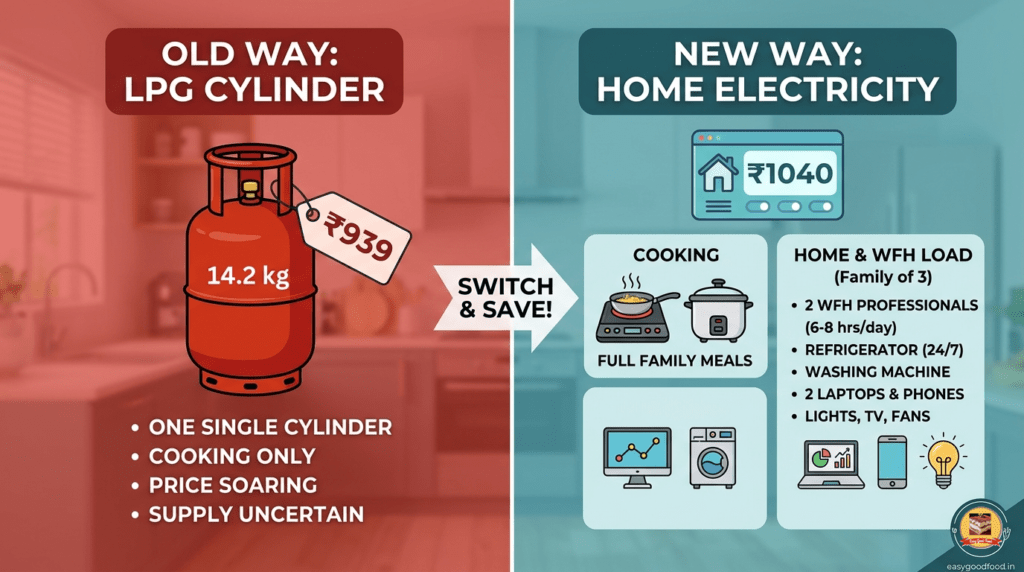
2. The “Zero-Outside-Food”: Real Monthly Energy Costs
Considering the health concerns of my mother (the elderly member), we rely on 100% fresh home-cooked food. Our kitchen appliances serve the daily requirement of breakfast, lunch, dinner, tea/coffee preps.
To provide a true comparison, I tracked our household’s transition from traditional gas cooking to a nearly 100% electric kitchen over the last 12 months.
For a typical family of three adults in West Bengal:
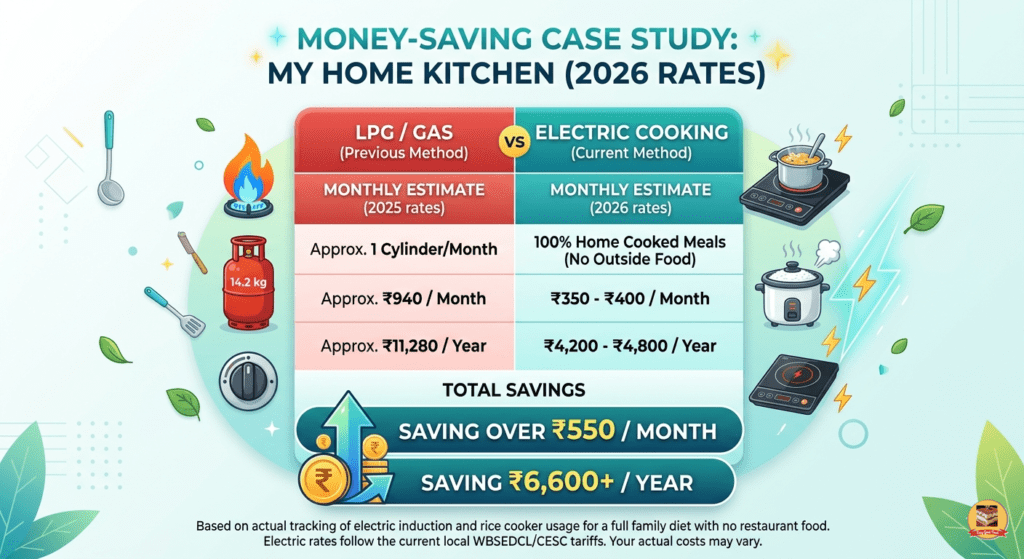
- LPG Exclusive: One cylinder lasts for a month on average. Monthly cost: ₹939.
- Electric Exclusive: The estimated cost of all-electricity cooking is around ₹350-400 per month.
The Verdict: By shifting our cooking to electric appliances entirely , we are saving nearly ₹500+ per month, or over ₹6000 annually.
Foundational Safety: Is Your Kitchen Ready for the Load?
Moving to an all-electric kitchen in 2026 is an efficient move, but it places a significant demand on your home’s wiring. High-power appliances like induction hobs (which can draw 1500W to 3000W) and electric rice cookers aren’t just “plug-and-play”—they require a solid electrical foundation to operate safely.
The Earthing Module is Non-Negotiable for Safety
In a properly wired home, the Earthing system acts as a safety net. If an appliance develops a fault or a wire comes loose, the excess electricity is instantly diverted into the ground instead of passing through you.
How to check your earthing at home:
- The Multimeter Test: Set your multimeter to AC voltage. Measure the voltage between the Neutral and Earth pins on your socket.
- Safe Range: Ideally, this should be less than 2 Volts.
- Danger Zone: If you see a reading above 5 Volts, your earthing is inadequate. This can lead to mild shocks when you touch the metal body of your rice cooker.
- The “ISI” Mark Requirement: As of March 19, 2026, new Quality Control Orders (QCO) make the ISI mark mandatory for most kitchen appliances. When buying new gear to beat the LPG crisis, ensure it carries this certification for verified insulation and shock protection.
Avoid the “Single Board” Trap: Preventing Kitchen Circuit Trips
The biggest mistake home cooks make is plugging an induction stove and a rice cooker into the same power strip or the same wall socket board.
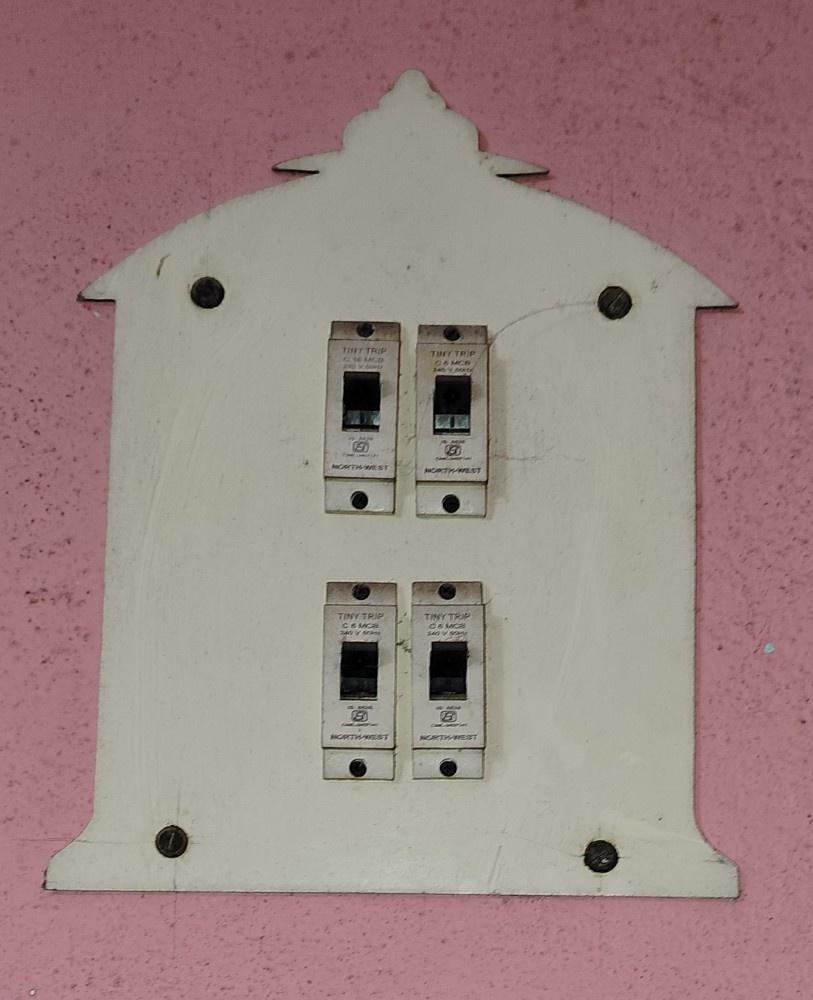
These multi-point MCBs were installed during a 2010 renovation, and they’ve proven to be a game-changer for our kitchen. By strategically splitting the electrical load across different boards, we’ve managed to run high-wattage appliances for years without a single tripping issue or short circuit. This setup is a perfect example of how proper planning prevents overloads in a modern, no-gas kitchen.
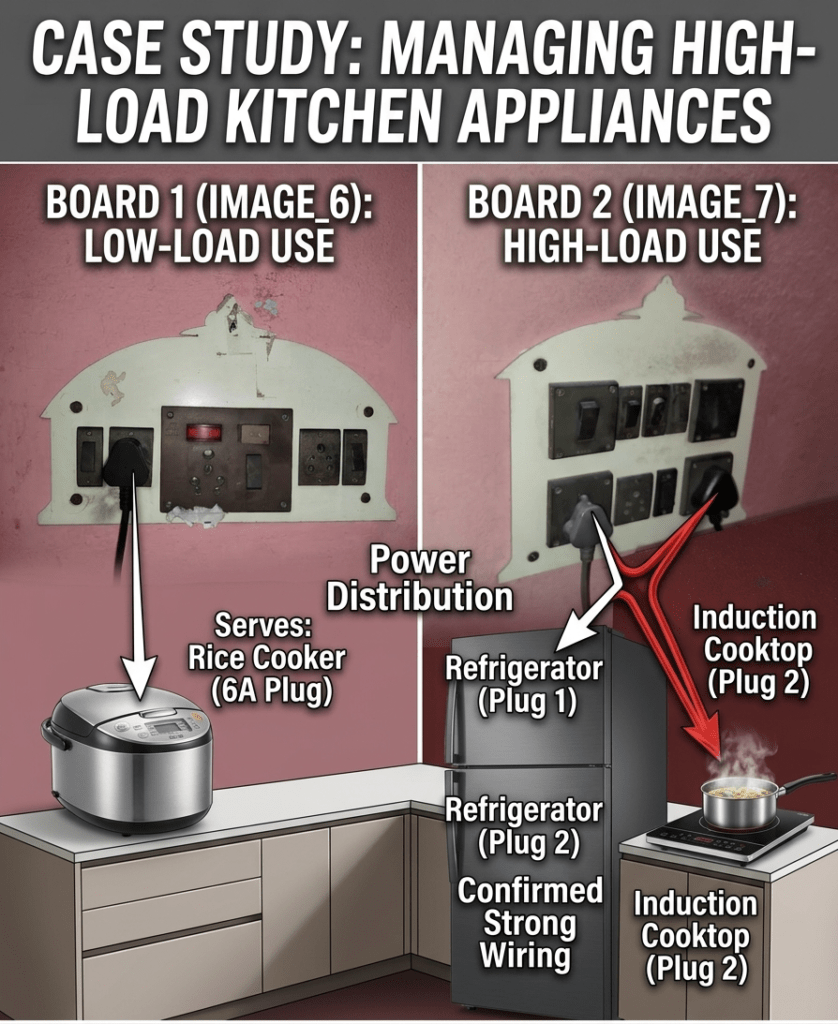
Most Indian kitchen circuits are rated for 15 to 16 Amps. Running both appliances at full power on one board can exceed this limit, leading to:
- Nuisance Tripping: Your MCB (Miniature Circuit Breaker) will constantly flip to “Off.”
- Socket Melting: Overloaded sockets generate intense heat, which can melt the plastic casing and become a fire hazard.
The Pro Strategy for 2026: Keep your heavy appliances “socially distanced.” Place your induction cooktop in the main kitchen area and move your rice cooker to a separate circuit—such as the dining room or a dedicated utility area. This “load balancing” ensures neither circuit is overwhelmed, allowing you to cook your meal and run your rice cooker simultaneously without worry.
Load Balancing: Managing Induction and Rice Cookers Together
Transitioning to a “no-gas” kitchen often brings up one major concern: Can my home’s electrical load handle multiple appliances at once?
While modern induction cooktops and electric rice cookers are efficient, using them simultaneously requires a bit of “load logic” to prevent blown fuses or overloaded circuits.
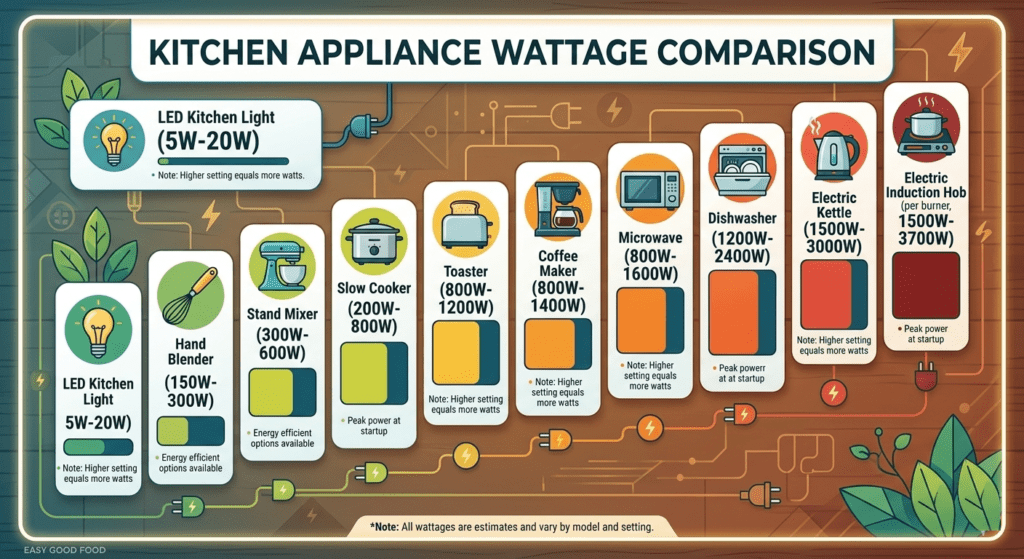
1. The “Staggered Start” Strategy
Most induction cooktops pull between 1200W to 2000W at peak power, while a standard electric rice cooker pulls about 600W to 800W.
- The Hack: Start your rice cooker first. Once the water reaches a boil and it settles into its steady cooking rhythm, then power on your induction for the main dish (like a dal or sabzi).
- Why it works: Appliances draw the most current during the initial heating phase. Staggering the start prevents a simultaneous power spike.
2. Utilizing the “Keep Warm” Phase
The beauty of the electric rice cooker is its insulation. You don’t need both appliances running at high heat at the same moment.
- Cook your grains or lentils in the rice cooker ahead of time.
- Once the cooker switches to “Warm” mode, its power consumption drops to a negligible 30W–50W.
- This leaves your entire electrical “budget” free for the induction cooktop to handle high-heat tasks like sautéing or boiling.
3. Power Setting Awareness
On most induction cooktops, you don’t always need the “Power” or “Boost” setting.
- Low & Slow: When cooking pure-veg recipes without onion and garlic, a medium heat often preserves the delicate flavors of the spices better.
- Balance: If you must use both at once, keep the induction on a medium setting (around 800W–1000W). This keeps your total draw under 2000W, which most standard Indian 15A kitchen sockets can handle comfortably.
4. Smart Plug & Socket Placement
Never plug both a high-wattage induction cooktop and a rice cooker into the same multi-plug or a low-quality extension cord. Ensure each is plugged into a dedicated 15A (large pin) socket.
Quick Tip: If you’re preparing a high-protein meal like a soya wrap, use the rice cooker to steam your soy chunks while the induction handles the seasoning. It’s the ultimate energy-efficient “multi-tasking” setup!
The Power-Cut Survival Guide: Cooking When the Grid Goes Down
For many Indian households, the biggest barrier to going 100% electric is the fear of “Load-Shedding.” While we enjoy reliable CESC power in our corner of West Bengal, I know that for much of the country, a power cut during lunch prep is a very real possibility especially in summer.
If you are transitioning to a modern electric kitchen, here is how to stay “Power-Proof” in 2026:
1. The “Inverter Hero”: The Electric Rice Cooker
Most standard home inverters (900VA to 1100VA) cannot handle the 2000W surge of an induction cooktop. However, a standard 600W–800W Electric Rice Cooker is a different story.
- Why it works: Most inverters can comfortably run a rice cooker. If the lights go out, your rice cooker stays on.
- The “Thermos” Effect: Even without an inverter, a good rice cooker is heavily insulated. If you finish cooking just as the power cuts, your rice and dal will stay steaming hot for up to 4 hours inside the sealed pot.
2. The Smart Inverter Choice
If you are planning to upgrade your home backup system this year, look for these two “Kitchen-Ready” specs:
- Pure Sine Wave: Essential for protecting the sensitive touch-panels and motherboards of induction stoves.
- 3kVA+ Capacity: If you want to run a 1500W induction setting during a blackout, you need a high-capacity inverter (3kVA or higher) with at least two tubular or lithium batteries.
3. The 2026 “Hybrid” Strategy
Even as an advocate for electric cooking, I recommend a “Safety First” approach for areas with unpredictable grids:
- Primary (90%): Use Induction and Rice Cookers for daily savings.
- Secondary (Backup): Keep a small, single-burner LPG stove or a high-quality camping stove in your utility area.
- The Ratio: Use the electric appliances whenever the grid is on to keep your monthly bill near that ₹1040 mark, and save the gas only for emergencies.
Efficient Electric Cooking – FAQs
Which is safer, a gas or an electric stove?
When comparing a gas stove to an electric stove, electric stoves—especially induction models—are widely considered the safer option for a modern home.
While both are reliable when used correctly, electric cooking eliminates several fundamental risks associated with open-flame combustion.
1. Fire Safety and Open Flames
The most immediate safety advantage of an electric stove is the absence of an open flame.
Gas: An exposed flame can easily ignite loose clothing, paper towels, or kitchen towels if they get too close. There is also a risk of the flame being blown out by a draft, leading to a silent gas leak.
Electric: There is no fire to manage. Induction cooktops go a step further by using magnetic currents to heat the pan directly, meaning the cooktop surface itself stays relatively cool to the touch, significantly reducing the risk of accidental burns.
2. Indoor Air Quality and Health
Safety isn’t just about burns; it’s also about what you breathe while cooking.
Gas: Burning natural gas or LPG releases byproducts like nitrogen dioxide (NO_2) and carbon monoxide (CO). Without heavy-duty ventilation, these gases can linger in the kitchen and affect respiratory health.
Electric: Electric cooking involves no combustion, meaning it produces zero indoor emissions. This keeps the air in your home cleaner and safer for everyone, particularly in smaller or less-ventilated kitchens.
3. Gas Leak and Explosion Risks
Gas: Gas stoves require a constant fuel connection. While rare, leaks in the pipes or a burner left “on” without being lit can lead to a buildup of gas, posing a risk of carbon monoxide poisoning or explosion.
Electric: Because they run on a standard or dedicated electrical circuit, there is no risk of fuel leaks. Modern electric stoves also come with automatic shut-off features if they detect overheating.
4. Stability and Precision
Induction Advantage: Many modern electric and induction stoves feature sensors that detect when a pan is removed and automatically cut the power. This prevents the unit from staying “on” indefinitely if you forget to turn it off.
Heat Distribution: Electric elements provide very stable, flat surfaces for cookware, reducing the chance of a pot tipping over compared to the raised grates often found on gas stoves.
Why are people switching from gas to electric stoves?
People are increasingly transitioning from gas to electric stoves—particularly induction models—due to a combination of health, economic, and environmental factors. As of early 2026, recent global energy shifts and new scientific research have accelerated this trend.
1. Health and Indoor Air Quality
Recent studies have highlighted that gas stoves are a significant source of indoor air pollution.
Respiratory Protection: Gas combustion releases nitrogen dioxide (NO_2) and fine particulate matter (PM_{2.5}), which are linked to a higher risk of childhood asthma and other respiratory issues.
Toxic Emissions: Research has shown that even when turned off, gas stoves can leak small amounts of benzene, a known carcinogen. Electric stoves provide a completely “emissions-free” cooking experience at the point of use.
2. Cost and Energy Efficiency
With global energy market fluctuations in 2025 and 2026, the economics of cooking have shifted.
Operating Costs: In many regions, including parts of India and the US, electricity has become more cost-effective than LPG or piped natural gas. Reports from 2026 indicate that households can save significantly on annual fuel bills by switching to electric cooking.
High Efficiency: Induction stoves are approximately 85-90% efficient, meaning almost all the energy goes directly into the food. In contrast, gas stoves are only about 40-55% efficient, as much of the heat escapes into the surrounding air.
3. Safety and Modern Technology
No Open Flames: Electric cooking eliminates the risk of grease fires catching an open flame or accidental gas leaks.
Precision and Speed: Modern induction cooktops can boil water twice as fast as gas and offer precise temperature control that was previously only available in professional kitchens.
Automatic Features: Many electric models include “pan detection” and automatic shut-off timers, providing peace of only.
4. Government Incentives and Subsidies
In 2026, governments are actively encouraging this shift to reduce reliance on imported fuels and meet climate goals.
Rebates: Many countries now offer tax credits or instant rebates for homeowners who replace gas appliances with high-efficiency electric ones.
Subsidies: Specific regions (such as Tamil Nadu in early 2026) have even introduced electricity subsidies for businesses and cloud kitchens that switch to electric stoves to combat gas shortages.
Is it worth replacing a gas stove with an electric?
In the context of 2026, the shift toward electric cooking in India is no longer just a trend—it has become a financial necessity for many households. With recent geopolitical tensions in early 2026 causing a surge in LPG prices and delivery delays, switching to electric is increasingly considered “worth it.”
Is it Worth the Switch?
For the average Indian household, the answer is yes, primarily due to operational savings and efficiency. While a gas flame loses about 60% of its heat to the surrounding air, an induction cooktop transfers 85-90% of its energy directly to the vessel.
Speed: You can boil water or cook dal significantly faster than on gas.
Safety: No risk of gas leaks or open flames, which is a major advantage in compact Indian kitchens.
Climate-Proof: Unlike LPG, which is tied to volatile global oil markets, electricity is domestically generated and increasingly powered by solar (supported by schemes like PM-Surya Ghar Yojana).
Cost Comparison (March 2026 Estimates)
The following table compares the cost of cooking for a standard meal (approximately 1 hour of active cooking) based on current market rates in major Indian cities.
| Cooking Method | Energy Used (per hour) | Average Rate | Cost per Hour |
| LPG Cylinder | ~0.1 kg | ₹913 – ₹939 (per 14.2kg) | ₹70 – ₹90 |
| Induction Cooktop | 1.5 – 2.0 Units | ₹6 – ₹10 (per unit) | ₹10 – ₹20 |
| Electric Coil Stove | 2.0 – 2.5 Units | ₹6 – ₹10 (per unit) | ₹15 – ₹30 |
| Piped Gas (PNG) | ~0.5 – 0.7 SCM | ₹50 – ₹55 (per SCM) | ₹25 – ₹40 |
Key Takeaway: Cooking with an induction stove is currently 37% cheaper than using a non-subsidized LPG cylinder. Over a year, an average household can save between ₹1,000 and ₹1,500 by moving their primary cooking to electric.
Important Considerations for Indian Homes
Upfront Investment: You will need to spend ₹2,000 to ₹4,000 on a quality induction cooktop. Additionally, you may need to invest in induction-compatible (ferromagnetic) stainless steel or cast-iron cookware.
Power Reliability: If you live in an area with frequent “load shedding,” it is best to use a “hybrid” approach—keep your gas stove for emergencies and use the electric stove for daily heavy cooking.
Electricity Slabs: If your monthly consumption is already high, adding an electric stove might push you into a higher billing slab. However, even at ₹9 per unit, induction remains cheaper than market-rate LPG.
Cooking Style: While induction is perfect for boiling, pressure cooking (dal/rice), and frying, some traditional techniques like roasting a baingan (eggplant) or puffing a roti directly on a flame still require a gas burner.
Future-Proofing Your Cooking Routine
Transitioning to electric cooking is the most resilient move a household can make in 2026. By mastering the safety protocols of induction and rice cookers, you protect your home from both electrical hazards and the volatility of global fuel prices.
Safety and efficiency are the new pillars of the modern kitchen. As we adapt to these energy shifts, these tools ensure that your meals remain uninterrupted, regardless of the challenges facing the global oil market. It is time to embrace a cleaner, safer, and more sustainable way to cook.
Related Posts:
Induction Cooking 101: Proven Tips to Save ₹1K+ Monthly 2026
Electric Rice Cooker Tutorial: Fluffy Parboiled Rice Guide
Rice Cooker Hacks 2026 – Mastering the Electric Rice Cooker
Safe Electric Cooking – Checklist
When managing multiple electric appliances, prioritizing safety is paramount. Keep this checklist handy:
Check Your Wiring and Outlets:
- Ensure your kitchen wiring is modern and can handle the combined load of your appliances. Older wiring might not be sufficient.
- Inspect outlets for signs of damage, scorching, or discoloration.
- Use heavy-duty 15A or 16A sockets specifically designed for high-wattage kitchen appliances for devices like induction cooktops and large rice cookers. Avoid plugging them into standard 5A or 6A sockets.
Avoid Overloading Outlets and Power Strips:
- Do not use multi-plug adapters or lightweight extension cords to power high-wattage appliances simultaneously. This is a common cause of electrical fires.
- Always plug major appliances directly into a dedicated wall outlet whenever possible.
Use High-Quality Cords and Appliances:
- Regularly inspect appliance cords for fraying, damage, or exposed wires. Replace any damaged cords immediately.
- Ensure your appliances and extension cords are rated appropriately for the wattage they will be carrying.
Practice Load Balancing Logic:
- Stagger the start times of your high-wattage appliances.
- Avoid running an electric kettle and an induction cooktop at peak power on the same circuit simultaneously.
- If possible, dedicate separate circuits for major kitchen appliance groupings.
Monitor Your Appliances:
- Never leave high-wattage appliances running unattended for extended periods.
- Regularly clean the ventilation areas of your induction cooktop to prevent overheating.
Don’t just read about it—see how it’s done!
Transitioning to electric cooking is easier when you see the process. Head over to the Easy Good Food YouTube channel for high-protein, pure-veg recipes designed specifically for electric cookers and induction cooktops.
Follow us on social media for the latest updates on more budget-friendly kitchen hacks!
Enjoyed this post? Join our community of home cooks! Subscribe to our YouTube channel and follow our social media handles for daily Vrat-friendly tips, induction cooking hacks, and authentic Indian flavors delivered straight to your feed.
Submit your review | |